
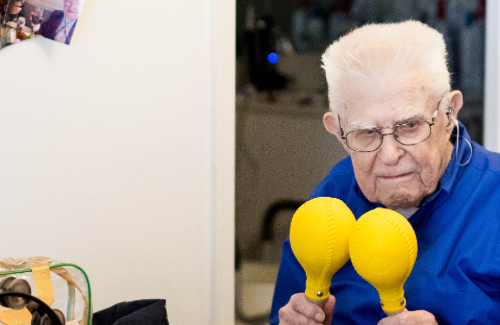
When I first met this senior client, he was living with the long-term effects of a traumatic brain injury that had progressed into dementia. Communication was limited, memory was inconsistent, and daily life often felt confusing and frustrating. His family, always attentive and hopeful, noticed something special: he would occasionally sit at the piano and play.
That spark led them to seek music therapy, hoping it might support his quality of life. None of us anticipated just how much music would unlock.
3 Outcomes of Music Therapy
Discovering the Singer Within
As our sessions began, it quickly became clear that music wasn’t just familiar—it was alive inside him. While exploring the piano and small percussion instruments, he began to sing. Not tentatively, but confidently. Expressively. Joyfully.
We started building sessions around songs he already knew and gently introducing new ones. Over time, I created six personalized lyric books, each containing more than 20 songs. Some tapped into long-held memories; others became brand-new learning experiences.
And he was learning.
Meaningful Signs of Progress
Through music, he demonstrated abilities that often seemed inaccessible in other contexts:
- Learning and remembering new songs
- Responding to verbal prompts
- Recalling my name
- Anticipating familiar routines
One of the most meaningful rituals became our closing song. At the end of each session, we sang a goodbye song to the tune of Mrs. Robinson, personalized with his name and his care companion’s name:
“Here’s to you…” and fill in whoever was there. After some practice, a majority of the time he would remember my name and the name of his caregiver.
Eventually, I would even simply say, “Let’s finish up by singing goodbye to the tune of…” And most of the time, he would smile and finish the sentence himself: “Mrs. Robinson!”
On days when the full title didn’t come, just hearing “Mrs…” was enough to spark the memory.
More Than Music: Therapeutic Relationship and Trust
Beyond the cognitive gains, what stood out most was the therapeutic relationship we built. He consistently expressed heartfelt gratitude, sharing how much he enjoyed our time together. Music gave him permission to be himself—to play, to sing, to create—without fear or pressure.
Family members sometimes joined our sessions, singing alongside him and witnessing moments of connection that felt rare elsewhere. On one unforgettable occasion, he even put on a small concert for his family—singing proudly, freely, and with unmistakable joy.
Why Music Therapy Matters for Seniors With Dementia
In a season of life marked by loss and limitation, music therapy became a space of freedom. It supported memory, encouraged learning, strengthened relationships, and—perhaps most importantly—brought genuine happiness during a deeply challenging time.
This experience is a powerful reminder that even when words fade, music often remains—waiting patiently to reconnect us to who we are.

Eric Lebowitz, MT-BC, LCAT, is a music therapist and founder of InVibe Creative Arts Therapy. He helps adults, dementia caregivers and family members, and seniors navigate stress, grief, and life transitions through music, creativity, and mindfulness. With training from Berklee and NYU, Eric blends neuroscience-informed care with accessible creative tools to help people feel grounded, capable, and connected to themselves and those they love.