
How Music Helps Seniors Reconnect, Respond, and Feel Joy Again
There’s something remarkable that often happens when music enters the room for someone living with dementia.
A person who has been quiet all afternoon suddenly starts humming. Someone who struggled to find words begins singing every lyric to a song from decades ago. A spouse sees their loved one smile — really smile — for the first time in weeks.
These moments can feel almost unbelievable when you’re living through the confusion, grief, and unpredictability dementia often brings. But they happen every day through music therapy.
At InVibe, we’ve seen firsthand how dementia and the power of music therapy can create moments of connection that feel meaningful, grounding, and deeply human. Not because music “cures” dementia, but because music reaches parts of the brain and spirit that often remain accessible long after other forms of communication become difficult.
And sometimes, even a few moments of joy, recognition, creativity, or calm can change the emotional tone of an entire day — for both seniors and the people who love them.
Creating Connection Beyond Words Through the Power of Music Therapy
Dementia changes the way people process language, memory, emotion, and interaction. Families often describe feeling like they’re slowly losing access to the person they know and love.
That’s part of what makes music so powerful.
Music engages multiple areas of the brain at once — including regions connected to memory, rhythm, emotion, and long-term recall. Familiar songs can bypass some of the communication barriers dementia creates and help people reconnect with experiences, feelings, and parts of themselves that still remain intact.
For some seniors, that looks like singing along to a favorite Frank Sinatra song. For others, it may be tapping their foot to Motown, recalling a dance hall memory, laughing during a drumming activity, or relaxing while listening to calming piano music.
The goal isn’t performance. It isn’t perfection. And it isn’t forcing someone to “improve.”
It’s creating meaningful moments of engagement, dignity, creativity, comfort, and human connection.
Sometimes the most important thing music therapy offers is simple:
A person who feels present again.
What Is Art and Music Therapy for Dementia?
Art and music therapy for dementia uses creative experiences to support emotional, cognitive, social, physical, and spiritual well-being.
Unlike passive entertainment, music therapy is guided intentionally by a trained professional who adapts sessions to each person’s cognitive level, personality, history, and emotional needs.
At InVibe, sessions may include:
- Singing familiar songs
- Music listening and discussion
- Guided relaxation or mindfulness with music
- Rhythm and movement activities
- Songwriting or lyric reflection
- Creative expression through journaling, storytelling, or art
- Improvisation and playful musical interaction
- Gentle cognitive engagement through memory-based music experiences
Importantly, clients do not need musical talent or artistic experience to benefit.
This work is not about being “good” at music or art.
It’s about using creativity as a pathway back to connection, identity, expression, and joy.
Enhancing the Lives of Seniors With Dementia Through the Power of Music Therapy
One of the biggest misconceptions about dementia care is that meaningful life experiences stop once memory loss progresses.
But even when memory changes, emotional experiences still matter profoundly.
Music therapy can help seniors feel more engaged, more comforted, more expressive, and more connected in the present moment.
Emotional Benefits
Dementia often brings frustration, anxiety, sadness, fear, isolation, and emotional withdrawal.
Music can help regulate emotion in a way that feels natural and accessible.
We often see seniors become calmer during sessions, laugh unexpectedly, express emotion more openly, or experience visible relief through familiar music. Songs tied to meaningful life memories can also help reinforce identity and emotional continuity.
For families, these moments can feel incredibly moving because they offer glimpses of the person they recognize beneath the illness.
And for the individual living with dementia, those moments matter too.
Even if they don’t remember the session later, they still experienced comfort, connection, and joy in that moment.
Cognitive Benefits
Music therapy for Alzheimer’s and dementia can also support cognitive engagement.
Rhythm, repetition, lyrics, and melody stimulate areas of the brain involved in attention, sequencing, memory recall, and processing. Familiar music may help trigger autobiographical memories that feel difficult to access otherwise.
Sometimes families are surprised when a loved one who struggles with conversation can still remember entire verses of songs learned decades earlier.
That isn’t accidental.
Musical memory is often stored differently than short-term verbal memory, which is why music can remain accessible even as dementia progresses.
Again, the goal is not to “reverse” dementia. The goal is to create opportunities for engagement, stimulation, and meaningful interaction.
Social Benefits
Isolation is one of the quietest but most painful parts of dementia.
As communication changes, many seniors begin withdrawing socially. Families may feel unsure how to connect. Conversations become harder. Visits can feel emotionally heavy.
Music creates shared experiences that don’t rely entirely on conversation.
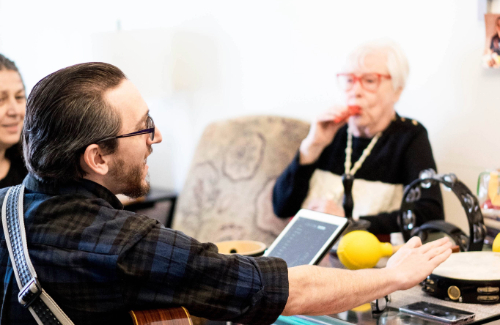
Singing together, clapping rhythms, reminiscing about favorite songs, or simply listening side-by-side can reduce pressure and create moments of togetherness that feel more natural and joyful.
For seniors in assisted living or memory care settings, music therapy can also increase participation, social interaction, and group engagement.
Physical & Behavioral Benefits
Music therapy may also support physical movement, relaxation, and behavioral regulation.
Rhythm naturally encourages movement. Even small motions — tapping fingers, swaying, walking, clapping — can help improve engagement and physical activation.
Music can also reduce agitation and restlessness in some individuals with dementia. Calm, familiar music may help ease transitions, lower anxiety, and create a more soothing environment.
For caregivers, this can bring moments of relief during what are often emotionally exhausting days.
How Art and Music Therapy Helps Families and Caregivers Feel More Connected
When someone you love has dementia, there’s often grief layered into everyday life.
Families frequently wonder:
“Am I doing enough?”
“Why does it feel harder to connect?”
“What actually helps?”
One of the most meaningful aspects of music therapy is that it doesn’t only support the individual living with dementia. It also supports the people around them.
Music creates opportunities for shared experiences instead of only focusing on decline or caregiving tasks. Families often participate in singing, storytelling, reminiscing, movement, or creative activities together.
These moments can help shift the emotional atmosphere from helplessness toward connection.
At InVibe, we believe pain and joy can coexist.
A family can still be grieving while also laughing together during a familiar song.
A spouse can still feel overwhelmed while also feeling relieved seeing their loved one engaged again.
A caregiver can still be exhausted while also finding comfort in knowing someone else is helping carry the emotional weight.
Those experiences matter.
What Families Say About Music Therapy for Their Loved Ones
Families often describe music therapy as one of the few experiences that still feels genuinely alive and emotionally meaningful for their loved one.
Sometimes they notice their parent becoming more engaged after weeks of withdrawal. Sometimes they see improved mood, more interaction, or fewer moments of agitation. Sometimes the biggest difference is simply that their loved one begins looking forward to something again.
One family member shared that after several sessions, her mother went from sitting silently through most visits to singing songs from her twenties and laughing during sessions.
Another described feeling relief because she no longer felt alone trying to create meaningful moments for her father.
These stories are deeply personal, but the common thread is often the same:
Music helps people feel more connected to themselves and to each other.
How InVibe Uses Dementia and the Power of Music Therapy to Support Seniors and Families
At InVibe Creative Arts Therapy, we approach dementia care with dignity, creativity, flexibility, and compassion.
Eric, the therapist behind InVibe, is a Board-Certified Music Therapist (MT-BC) and Licensed Creative Arts Therapist (LCAT) with over 10 years of experience supporting seniors, caregivers, and families through dementia, grief, aging, and life transitions.
Sessions are personalized based on each person’s history, interests, cognitive abilities, and emotional needs. Some clients respond best to singing and reminiscence. Others engage more through movement, humor, rhythm, mindfulness, or quiet listening experiences.
There is no pressure to perform, remember perfectly, or participate in a specific way.
The focus is always on creating meaningful moments of connection and improving quality of life in ways that feel human, respectful, and emotionally supportive.
Because even in difficult seasons of life, people still deserve joy.
They still deserve dignity.
They still deserve meaningful connection.
And sometimes music helps open that door again.
Want to explore Music Therapy for yourself or a loved one? Schedule a consultation to learn more.
FAQs About Dementia and the Power of Music Therapy
Can music therapy really help someone with dementia?
Yes. While music therapy does not cure dementia, it can support emotional well-being, cognitive engagement, social connection, relaxation, and quality of life. Many seniors respond positively to familiar music even when other forms of communication become difficult.
Why do dementia patients remember music?
Musical memory is often processed differently than short-term verbal memory. Familiar songs can activate emotional and long-term memory networks in the brain, which may remain accessible longer during dementia progression.
What are the benefits of art and music therapy for dementia patients?
Art and music therapy for dementia may support emotional expression, memory recall, social interaction, reduced anxiety, improved engagement, movement, relaxation, and moments of joy and connection.
Is music therapy only for late-stage dementia?
No. Music therapy can benefit individuals across many stages of dementia. Sessions are adapted based on each person’s needs, cognitive abilities, and comfort level.
What kinds of art and music work best for dementia therapy?
Familiar and emotionally meaningful music tends to be especially effective. This often includes songs connected to a person’s youth, culture, family memories, or important life experiences. Creative activities are personalized rather than one-size-fits-all.
How do I know my loved one with dementia will respond positively to music therapy?
Every person responds differently, but many families are surprised by how naturally music encourages engagement and emotional connection. At InVibe, sessions are tailored gently and flexibly to meet each person where they are without pressure or expectation.

Eric Lebowitz, MT-BC, LCAT, is a music therapist and founder of InVibe Creative Arts Therapy. He helps adults, dementia caregivers and family members, and seniors navigate stress, grief, and life transitions through music, creativity, and mindfulness. With training from Berklee and NYU, Eric blends neuroscience-informed care with accessible creative tools to help people feel grounded, capable, and connected to themselves and those they love.